Traditional Farmhouse Exterior Ideas That Honor Simplicity, Symmetry, and Honest Craft
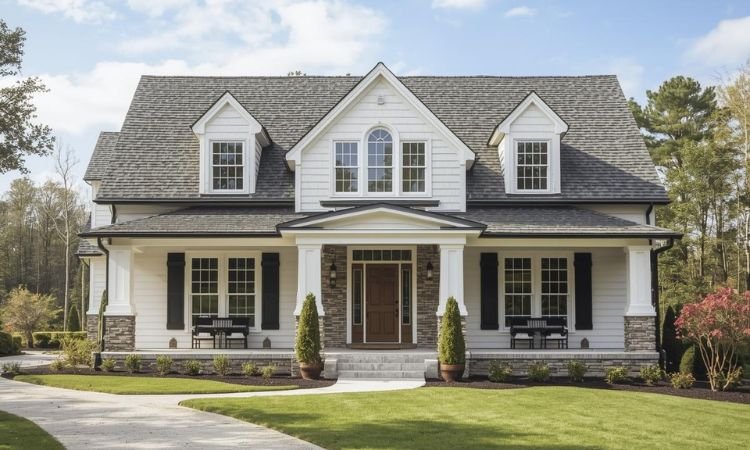
A traditional farmhouse exterior draws from 19th- and early 20th-century rural American design—think white clapboard siding, a centered front door, and a full-width porch with square columns.
These homes were built for function: wide eaves for shade, tall windows for cross-ventilation, and porches for outdoor living. Most range from 1,800 to 3,000 sq ft, with roof pitches of 8:12 to 10:12 and porches 6’–10′ deep.
These 10 ideas focus on historical accuracy, balanced composition, and practical details that work in both historic restorations and new builds.
Why This Style Endures
Symmetry creates calm: Centered doors and evenly spaced windows feel orderly without being stiff.
Porches are functional: They provide shade, circulation, and a place to sit—not just curb appeal.
Wood siding breathes: Clapboard and shiplap expand and contract naturally with humidity.
Neutral palette lets form shine: White, cream, or soft gray walls keep attention on architecture, not color.
10 Traditional Farmhouse Exterior Ideas That Honor Simplicity, Symmetry, and Honest Craft
All concepts reflect pre-1940s American farmhouse design and suit standard residential lots.
1. White Clapboard Siding with Green or Black Shutters
Install horizontal lap siding in smooth pine or cedar, painted crisp white, and add functional louvered shutters in forest green or matte black.
Shutters should be sized to cover the window when closed—never decorative only—and mounted with forged iron hinges for authenticity.
2. Full-Width Front Porch with Square Columns
Build a covered porch spanning the entire front facade, supported by simple square wood columns on stone or brick piers.
Keep railings low (36″ high) with square balusters, and use tongue-and-groove flooring that matches the home’s interior floors for continuity.
3. Centered Front Door with Transom and Sidelights
Place a paneled wood door at the exact center of the facade, flanked by matching sidelights and topped with a rectangular transom.
Paint the door in a classic color like black, navy, or forest green, and use brass or oil-rubbed bronze hardware for period accuracy.
4. Double-Hung Windows with 6-over-6 Panes
Install true divided-light or simulated double-hung windows with six panes over six in every opening, aligned vertically and horizontally.
Avoid picture windows or casements; traditional farmhouses used operable sashes for ventilation and consistent rhythm across the elevation.
5. Gable Roof with Moderate Pitch (8:12–10:12)
Use a simple gable roof with asphalt shingles or cedar shakes in charcoal or gray, extending 12″–18″ beyond the walls for shade.
Add exposed rafter tails or simple crown molding at the eaves for subtle detail—never ornate brackets or gingerbread trim.
6. Brick or Stone Foundation Skirt
Anchor the home with a visible foundation of red brick, fieldstone, or concrete block painted to match the trim.
This base protects siding from splash-back and visually grounds the light-colored walls above in the landscape.
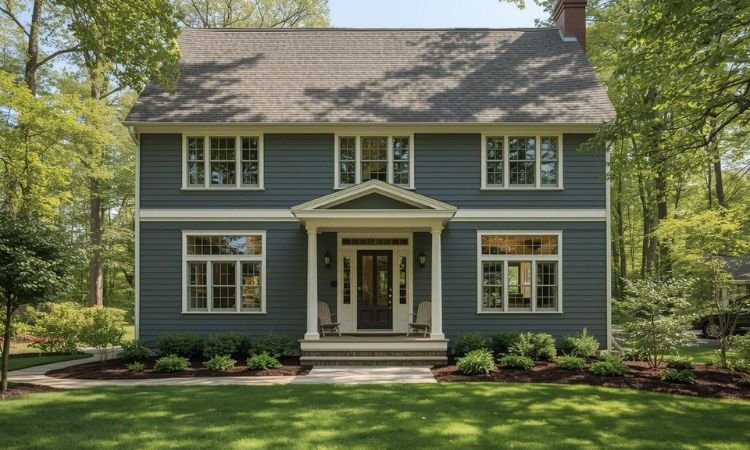
7. Symmetrical Facade with Balanced Window Placement
Maintain perfect symmetry: two windows on each side of the door on the first floor, and three evenly spaced above on the second.
Even garage placement matters—attach it to the side or rear, never centered, to preserve the main elevation’s balance.
8. Wood Garage Doors with Vertical Panels
Choose carriage-style garage doors in vertical tongue-and-groove pine or cedar, painted to match the house or stained natural.
Add wrought iron strap hinges and handles for detail, and avoid raised-panel or steel doors that break the traditional aesthetic.
9. Simple Crown Molding and Corner Boards
Add minimal trim: 4″–6″ corner boards, 3″–4″ window and door casings, and a modest crown molding under the eaves.
Keep profiles clean—no ogees or dentils—and paint all trim the same white as the siding for a unified, crisp look.
10. Boxwood Hedges and Flagstone Walkway
Landscape with low boxwood hedges lining a straight flagstone or brick path to the front door, flanked by two matching urns or lanterns.
Avoid flower beds or curved paths; traditional farmhouses favored order, utility, and clear access over ornamental gardening.
Common Mistakes and Fixes
- Using vinyl shutters that don’t function
Fix: Install real louvered wood shutters that can close over the glass, or skip them entirely. - Breaking symmetry with off-center garage
Fix: Place the garage on the side or rear. If attached, use carriage doors and match siding to minimize visual impact. - Choosing modern window styles
Fix: Stick to double-hung with 6-over-6 grilles. Casements and fixed panes feel contemporary, not traditional. - Adding excessive ornamentation
Fix: Skip corbels, brackets, and decorative shingles. Traditional farmhouses were plain by necessity and taste. - Ignoring porch depth
Fix: Make the porch at least 6′ deep—deep enough for chairs and walking behind them without crowding.
Build Like It’s Always Been There
A true traditional farmhouse doesn’t try to impress—it serves. Every detail exists for a reason: shade, air, shelter, or simplicity.
Skip the trends. Honor proportion, use honest materials, and let time add the character.
Have you restored or built a traditional farmhouse? Did you go with white clapboard, 6-over-6 windows, or a full porch?
Share your experience in the comments—we’d love to hear how you’ve kept this timeless style alive.