1800s Farmhouse Exterior Ideas That Honor Authentic Rural Craft and Practical Design
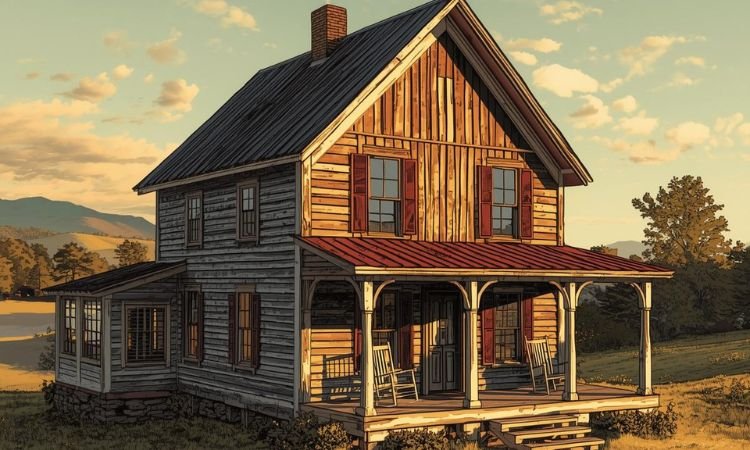
An 1800s farmhouse wasn’t built for curb appeal—it was built to work. These homes featured simple forms, local materials, and layouts shaped by function: a central door, symmetrical windows, a full-width porch, and a gable roof with minimal overhang.
Most ranged from 1,200 to 2,200 sq ft, with clapboard or shiplap siding, brick or stone foundations, and porches just deep enough for sitting out of the sun.
These 11 ideas focus on historical accuracy, regional materials, and restrained detailing that reflect how rural Americans actually lived.
Why 1800s Design Still Works Today
Simplicity reduces upkeep: No ornate brackets, no fake shutters—just wood, glass, and brick.
Symmetry creates calm: Balanced windows and centered doors feel orderly without being stiff.
Porches served real needs: Shade, circulation, and a place to shell peas or watch storms roll in.
Local materials ruled: Siding came from nearby mills; stone from field clearing; brick from on-site clay.
11 1800s Farmhouse Exterior Ideas That Honor Authentic Rural Craft and Practical Design
All concepts reflect pre-1900 American farmhouse design and suit standard rural or suburban lots.
1. White-Painted Clapboard Siding with Minimal Trim
Install horizontal lap siding in pine or cedar, painted white with linseed oil-based paint, and add only essential trim: 3″ corner boards and simple window casings.
Avoid crown molding, gingerbread, or decorative shingles—1800s builders used what was necessary, not ornamental.
2. Full-Width Porch with Square Wood Posts
Build a covered porch spanning the front facade, supported by plain square wood posts on brick or stone piers, with a tongue-and-groove floor matching interior floors.
Keep railings low (36″) with square balusters or none at all—many early porches had no railings if under 30″ high.
3. Centered Front Door with Simple Transom
Place a paneled wood door at the exact center of the facade, topped with a single rectangular transom for light but no sidelights.
Paint the door dark green, black, or red—the few colors available to rural households—and use cast-iron or brass hardware.
4. Double-Hung Windows with 6-over-6 Panes
Install true divided-light double-hung windows with six panes over six in every opening, aligned vertically and horizontally across the facade.
Glass was expensive, so windows were modest—typically 28″x56″—and always operable for summer ventilation.
5. Gable Roof with Cedar Shakes or Wood Shingles
Use a simple gable roof with a pitch of 8:12 to 10:12, covered in hand-split cedar shakes or wood shingles, extending 12″–18″ beyond the walls.
No gutters were common; wide overhangs directed rain away from the foundation and siding.
6. Brick or Fieldstone Foundation
Anchor the home on a visible foundation of locally sourced brick, fieldstone, or dry-stack stone, typically 18″–30″ high.
This base protected wood siding from ground moisture and rodents, and often housed a root cellar or storage space.
7. Functional Louvered Shutters in Dark Green or Black
Add real louvered wood shutters sized to cover each window when closed, mounted with forged iron hinges for storm protection or privacy.
Shutters were never decorative—they were essential for winter insulation and summer shade.
8. Symmetrical Facade with Balanced Window Placement
Maintain strict symmetry: two windows on each side of the door on the first floor, and three evenly spaced above on the second.
Even outbuildings like smokehouses or springhouses were placed to preserve the main house’s balance.
9. Simple Chimney on Gable End
Build a single brick chimney on one gable end—never centered—to vent the kitchen stove and parlor fireplace.
Chimneys were functional, not decorative, and often extended just above the roofline without caps or pots.
10. Dirt or Gravel Yard with Straight Path
Forego lawns (a 20th-century invention) for a packed dirt or gravel yard with a straight path of brick, stone, or wood planks to the front door.
Plantings were practical: herbs by the kitchen door, lilacs for fragrance, and fruit trees for food—not ornamental flowers.
11. No Garage, No Overhangs, No Extras
Leave off garages, porte-cocheres, bay windows, and dormers—all modern additions. The 1800s farmhouse stood alone, unadorned, and self-sufficient.
If needed, a detached barn or carriage house sat behind the home, connected by a well-worn path.
Common Mistakes and Fixes
- Adding Victorian trim or brackets
Fix: Stick to pre-1880 simplicity. Gingerbread, spindles, and ornate brackets came later with railroads and mass production. - Using vinyl or fiber cement siding
Fix: For authenticity, use wood. If durability is the focus point, choose primed fiber cement but paint it to mimic wood grain. - Installing picture windows or casements
Fix: Only use double-hung with 6-over-6 grilles. Large fixed panes didn’t exist in rural 1800s homes. - Painting the whole house one color
Fix: Traditional farms used white or light yellow for walls, dark green/black for doors and shutters, and natural wood for porches. - Adding a centered garage
Fix: Keep vehicles separate. A true 1800s home had no garage—cars didn’t exist until the 1900s.
Build Like It Was Meant to Last
An 1800s farmhouse wasn’t designed to impress—it was built to endure. Every nail, board, and brick had a purpose. Skip the extras. Honor proportion, use honest materials, and let utility lead the way.
Have you restored or built a home inspired by 1800s farmhouses? Did you use clapboard siding, 6-over-6 windows, or a full porch?
Lets share your experience in the comments—we’d love to hear how you’ve kept this practical, timeless style alive.